
This week’s shtetl is Kuršėnai, Kurshan in Yiddish.
I first visited Kuršėnai in October 2025. I wanted to “greet” the memorial stele marking the former synagogue, erected by the Jakovas Bunka Foundation, and to take a closer look at this small town that I so often pass through, but rarely stop in.
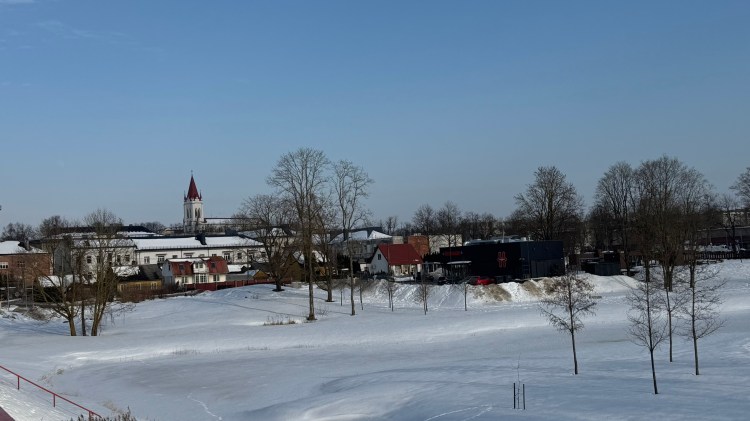
A few months later, in February 2026, ” I joined a guided tour about the Jews of Kuršėnai, organized by “Įdomūs Kuršėnai.” It was a chance to deepen my knowledge, meet local experts on Jewish heritage, and explore the town more closely.
The Jewish community of Kuršėnai began to take shape in the mid-18th century. By the end of the 19th century, 1,542 Jews lived in the town – 48% of the total population. Emigration, fires, and the upheavals of the early 20th century significantly reduced this number, yet during the interwar period about 900 Jews still lived here.
Between 70% and 90% of the town’s shops and workshops belonged to Jewish owners. There was a primary school teaching in Hebrew, a kindergarten, and a library with around 500 books in Yiddish and Hebrew. Jewish-owned cafés, taverns, restaurants, and even a cinema operated in the town.
Community members were active in political, youth, sports, and charitable organizations such as HaShomer HaTsair, Tseirei Zion, Betar, Maccabi, Ezrah, Bikur Holim, and Gemiluth Hesed. There was also a Jewish People’s Bank (Volksbank), the craftsmen’s mutual aid society, and local branches of the Small Traders’ Central Union and the OZE health organization.
During the interwar period, Kuršėnai had two houses of prayer. Until 1924, Rabbi Yitshak Fridman (founder of the Mizrakhi movement in Lithuania) served here before emigrating to Palestine in 1935. Another rabbi, Israel Rif (1870–1941), served the community until its final years; he was murdered together with his family during the Holocaust.
With the German occupation in 1941, Jewish life in Kuršėnai was systematically destroyed. The annihilation of the community unfolded in three stages: in July 1941, more than 100 Jewish men were shot near Kuršėnai; in September, approximately 500–600 people (mostly women and children) were murdered in Žagarė. Those who survived the mass shootings of 1941 and the forced labor camps in nearby factories were killed in January 1944 in Kužiai.
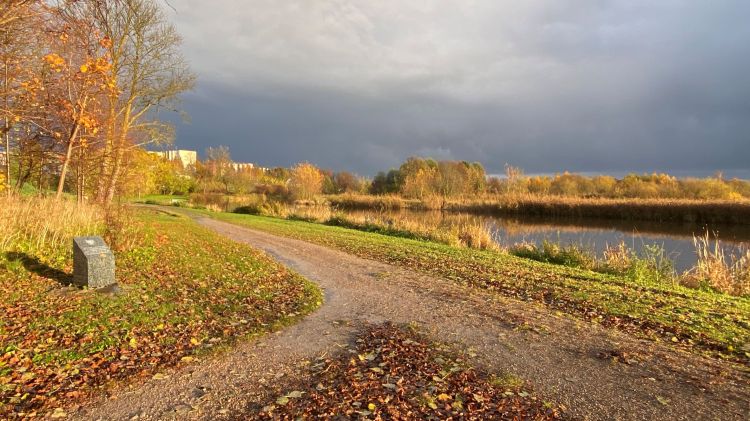
Today, little Jewish heritage remains visible in Kuršėnai. A solitary stele stands by the river, marking the site of the former synagogue. It reminds us of the community that lived, worked, studied, and prayed here.
Read more about this week’s shtetl KURŠĖNAI | KURSHAN
 Litvak Shtetls